
The Rooted Path™ | Kingdom Assets LLC
"Most frameworks begin with the mission. The Rooted Path™ begins with the formation. Because a congregation that has not yet discovered who it is cannot yet discover what it is called to do."
FORMATION BEFORE MISSION
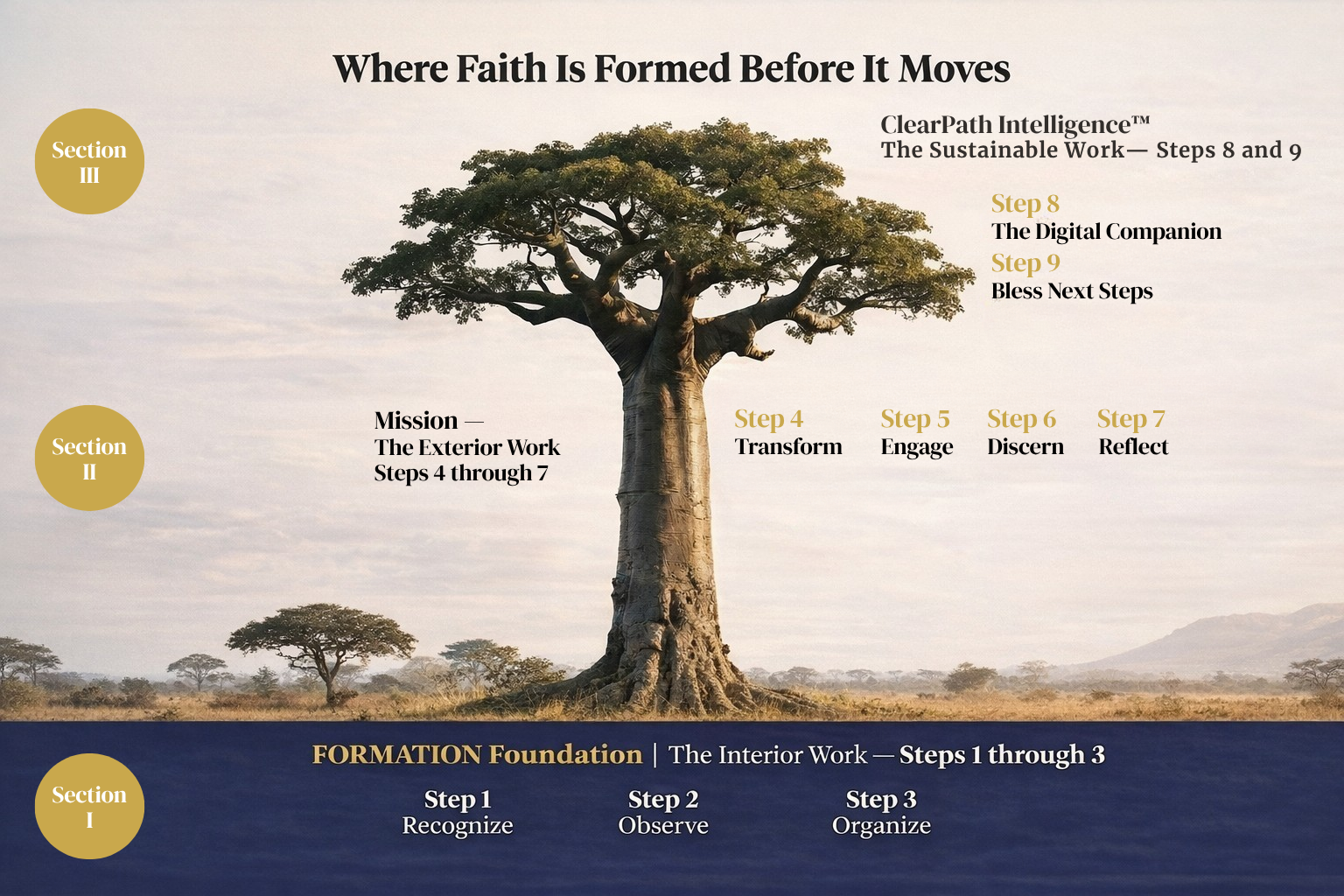
The nine steps of The Rooted Path™ are not a program to be completed. They are a practice to be inhabited. They move a congregation from passive presence in its community to purposeful, formation-rooted action. Each step builds on what came before it. None can be skipped without consequence. Together they form the operating system the faith-based community development field has never had.
Recognize
Recognition is the first act of formation. Before anything is built, something must be seen. This step asks the congregation to stop and acknowledge what is already present in its community, not what is missing, not what needs to be fixed, but what God has already placed there. This is not an assessment. It is an act of theological attention.
The congregation that learns to recognize begins to understand that the divine was present before they arrived. Their role is not to bring something from the outside in. Their role is to surface what has always been there. That shift in orientation changes everything that follows.
Observe
Observation is not the same as analysis. Analysis looks for problems. Observation looks for presence. In this step, the congregation develops the discipline of watching. Watching how people move through the community. Watching where energy gathers naturally. Watching what the neighborhood is already doing well without anyone’s intervention.
This is the step that reveals assets before needs, gifts before gaps. Most community development frameworks move from the recognition of a problem directly to the organization of a response. The Rooted Path™ insists on the discipline of extended observation because what you see in the first week is almost never what is actually there.
Communities reveal themselves slowly to those who have earned their trust. Observe protects against the false confidence that comes from arriving with a plan. It creates the conditions for something more durable: genuine understanding.
Organize
Organization in The Rooted Path™ is not the construction of a new institution. It is the alignment of what already exists. In this step, the congregation takes what Recognize and Observe have surfaced and begins to structure it. Identifying who carries natural leadership. Discovering which relationships already anchor the community. Naming where informal networks are doing the work that programs claim to do.
Formation-driven organization works from the inside out, not from the top down. It does not impose structure on community. It discovers structure within community and honors it. That distinction matters because organizations built on imposed structure require constant maintenance to survive.
Organizations built on discovered structure tend to self-sustain because they were already alive before anyone formalized them. Organize makes visible what was already real.
Transform
Transformation is the most misunderstood word in the community development vocabulary. Most programs use it as a synonym for change, as if transformation is something that happens to a community when the right intervention arrives. The Rooted Path™ holds a different view.
Transformation is not the result of an external force applied to a passive recipient. It is the result of an encounter between what a community always carried and what it finally had permission to become. In this step, the congregation moves from observation and organization into the active work of internal change. Not change imposed from outside. Change that emerges from within.
The congregation begins to see itself differently. And when a people see themselves differently, they begin to act differently. That sequence cannot be reversed. No program can produce it. Only formation can.
Engage
Engagement is the step where the congregation moves from internal formation to external presence. This is not outreach in the traditional sense. It is not a program launched at a neighborhood. It is a congregation, already formed, already organized, already transformed in its understanding of itself, stepping into the community as a neighbor rather than as a service provider.
The distinction is not subtle. A service provider arrives with an answer. A neighbor arrives with a question. Engagement in The Rooted Path™ is rooted in presence and relationship, not in programs and deliverables.
The congregation that has completed the FORMATION steps is ready to engage because it is no longer trying to fix what is outside. It is ready to join what is already moving. That posture changes every conversation, every partnership, and every outcome that follows.
Discern
Discernment is the practice of asking not just what can be done, but what should be done. It is the theological counterweight to the urgency that drives most community work. In this step, the congregation pauses in the midst of engagement to listen. To the community. To its own formation. And to the call that emerges from the intersection of both.
Discernment is where strategy and spirit meet. The congregation that skips this step tends to replicate programs that worked elsewhere, regardless of whether they fit here. The congregation that takes discernment seriously builds something that could only exist in this community, with these people, in this moment.
That specificity is not a limitation. It is the source of the framework’s power. What is built through discernment lasts because it belongs here. It was not imported. It was called forth.
Reflect
Reflection is not evaluation. Evaluation asks whether the program worked. Reflection asks what the work revealed. In this step, the congregation builds the discipline of looking back in order to move forward with greater clarity. It surfaces what was learned, what was unexpected, what needs to be carried forward and what needs to be released.
Reflection is the step that prevents the congregation from repeating itself across cycles of community work. It is also the step that deepens formation. Because every encounter with the community is simultaneously an encounter with the congregation itself. What you learn about your neighbors teaches you something about your own calling.
Reflection holds space for that learning. It does not rush toward the next action. It trusts that the pause is part of the work.
The Digital Companion
Powered by ClearPath Intelligence™
At this stage in the journey, the congregation has developed something rare and valuable: a living record of its own formation. It knows its gifts. It knows its context. It knows its assets and its relationships and the patterns that connect them.
ClearPath Intelligence™ is the technology layer built to hold that knowledge, organize it, and surface it in ways that make the congregation’s next step clearer. It is not a database. It is not a management system. It is a companion. One that remembers what the congregation has learned and helps it see patterns that would otherwise remain invisible.
The five engines of ClearPath Intelligence™ do not replace the formation work of the first seven steps. They amplify it. GiftScape™ maps the gifts already present in the congregation. ContextScape™ holds the story of the community. ResourceScape™ connects idle assets to active needs. Ministry Match™ and Opportunity Match™ close the gap between what congregations carry and what their communities require. The framework leads. The technology serves.
Bless Next Steps
The final step of The Rooted Path™ is not a conclusion. It is a commissioning. To bless next steps is to acknowledge that the congregation has completed a cycle of formation and is now ready to carry what it has learned into the next.
This step holds a dual meaning. The congregation blesses the community it has served, releasing it with the dignity and agency it came to recognize in the first step. And it blesses its own next movement, acknowledging that formation is not a destination but a practice.
Every congregation that completes The Rooted Path™ returns to Recognize with new eyes, new relationships, and new capacity. The journey is not circular. It is spiral. Each return to the beginning carries the full weight of everything learned on the way. What looked like the end was always the next beginning.
“The nine steps are not a checklist. They are a posture. A congregation that moves through them is not completing a program. It is developing a way of seeing its community, its calling, and itself that will sustain every mission that follows.”
If you’ve seen yourself in this, don’t study it longer. Begin.